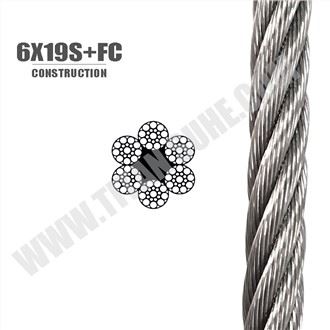
To choose the right wire rope, we should know its construction, size, strength, surafce you need. Today we discuss 6×19 wire rope and 6×37 wire rope. Choosing these two constructions depends more on bending fatigue than breaking strength. Both constructions comply with EN 12385, yet their strand design produces different mechanical behavior. In my experience reviewing lifting specifications for port cranes and winch systems, engineers often choose 6×37 simply because it feels more flexible, although that is not always the most durable option.
| Construction | Approx. Wires | Standard | Main Advantage | Typical Application |
| 6×19 | 114–133 | EN12385 (DIN3060) | Higher abrasion resistance | Cranes, slings, lifting, drawing, and finished net dragging |
| 6×37 | 222–259 | EN12385 (DIN3066) | Superior flexibility | Winches, sheaves, multi-layer winding |

The larger number of individual wires in a 6×37 wire rope reduces bending stress over small-diameter sheaves (typically D/d ≥18), while 6×19 wire rope withstands external wear more effectively because each outer wire has a larger cross-section. For lifting equipment exposed to abrasive conditions, I generally regard 6×19 as the longer-lasting solution. Where repeated bending dominates the duty cycle, however, 6×37 usually delivers better fatigue performance despite slightly lower abrasion resistance.
If need any other help for wire ropes, just contact TITANSUHE for more help.