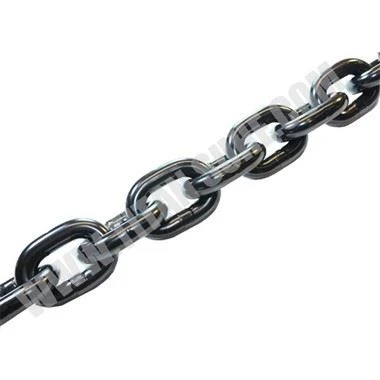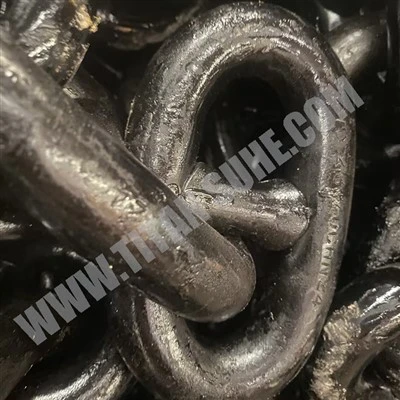
When selecting lifting chain, early assessment of chain surface smoothness is critical for safe hoisting operations, but do not only focus on WLL, grade. Why? You can see below case, during regular inspection of Ningbo mid-sized logistics yard, several Grade 80 hoist chains (EN818 compliant) with a nominal diameter of 10 mm showed micro-weld protrusions exceeding 0.3 mm, which caused link jamming during dynamic testing at 1.25×WLL. So a high-quality hoist chain should have a smooth finish free from cracks, corrosion, excessive weld spatter, or surface defects.
Surface smoothness is not only a tactile measure; it affects link articulation and fatigue performance under cyclic loads. EN 818-7 recommends that welded chain links must have no sharp edges or slag exceeding 0.2–0.4 mm. Chains with uniform, polished weld seams distribute tensile stress evenly, preventing localized stress concentrations and reducing the risk of torsion or sudden load shift.
Surface quality directly reflects manufacturing precision. During chain production, each link is welded, heat-treated, and calibrated. Poorly finished weld seams or residual slag can interfere with the movement of adjacent links. In one warehouse inspection, several chains with rough weld areas developed link binding after repeated lifting cycles, causing sudden load redistribution when the links finally released.
| Inspection Point | What to Check |
| Weld Area | Smooth transition without excessive weld spatter |
| Surface Finish | Uniform and free of sharp edges |
| Link Movement | Links should articulate freely |
| Defects | No cracks, pits, or corrosion marks |
In practice, observing visual defects, testing link rotation, and confirming compliance with grade and standard numbers ensures that hoist chains operate reliably. Personal field observations indicate that even small surface irregularities can significantly impact lifting stability, especially during high-frequency cycles or eccentric loading. A smooth lifting chain reduces the risk of twisting, jamming, and shock loading. Therefore, alongside rated capacity and compliance markings, surface smoothness should be a key criterion when selecting a chain for lifting operations.