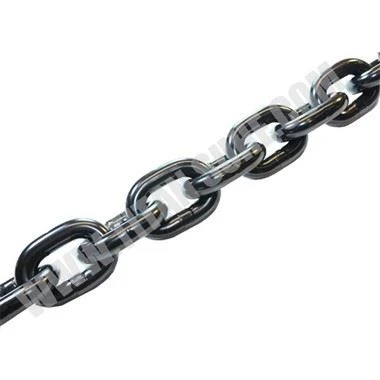
When a lifting chain is specified as "G80, 13 mm", that still leaves several important details open. The chain grade, nominal diameter and working load limit (WLL) are related, but they are not interchangeable specifications. The sling configuration, applicable standard and intended working conditions also need to be considered.
For Grade 80 lifting chain, EN 818-2 is a commonly referenced standard in European markets. It covers short-link welded chain for lifting purposes, including dimensions, mechanical properties, proof force and testing requirements. A quotation based only on chain diameter therefore does not tell the whole story.
G80 Is More Than a Chain Diameter
G80, or Grade 80, identifies a lifting-chain grade rather than a particular size.
This distinction matters when comparing suppliers. A 10 mm chain from one product range cannot be judged against another simply because both are described as "10 mm G80". The steel specification, heat treatment, chain dimensions, test requirements and applicable standard all form part of the product specification.
For lifting applications, ordinary welded chain should not be treated as an alternative just because its dimensions look similar. Grade 80 lifting chain is manufactured and tested for a defined lifting application.
That is also why an RFQ saying "G80 chain, 13 mm" may lead to further questions from a manufacturer. The required WLL and intended use usually need to be confirmed before the specification is complete.
Start With WLL, Then Check Chain Size
Chain diameter is often the first number discussed, but WLL is usually the more useful starting point.
The capacity of a chain sling depends on more than the chain itself. A single-leg sling, two-leg sling or four-leg sling can have different rated capacities, and the angle between sling legs also affects the working load.
For loose chain, the applicable standard and product data provide the relevant working load. Once the chain becomes part of a sling assembly, the complete assembly has to be considered.
As an example, published EN 818-2 Grade 80 chain data from RUD gives a WLL of 1.12 tonnes for 6 mm chain, 2.00 tonnes for 8 mm and 3.15 tonnes for 10 mm in its specified product range. These figures should not be copied into another manufacturer's catalogue without checking the corresponding specification.
So if a customer asks for "13 mm G80 chain", the useful follow-up is not simply to confirm the diameter. It is to establish what load the chain needs to carry and whether it will be used as loose chain or assembled into a lifting sling.
EN 818-2: What Does It Tell You?
For buyers working with European specifications, EN 818-2 is one of the standards worth checking.
It covers Grade 8 short-link lifting chain and sets requirements for areas such as dimensions, manufacturing, mechanical properties and testing. The standard is concerned with chain intended for lifting, rather than general-purpose welded chain.
This distinction is useful when reviewing supplier quotations. If one quotation simply says "Grade 80" while another specifies EN 818-2 and provides corresponding test documentation, they may not be describing the product at the same level of detail.
The required standard should also match the destination market and the customer's own technical specification. EN 818-2 should not automatically be treated as the applicable standard for every country or application.
What Matters During Supplier Comparison
Price comparisons become less useful when the technical specifications are different.
A typical purchasing sheet may include chain grade, diameter, WLL, standard, surface condition, proof testing and documentation. Depending on the project, the customer may also require batch identification, material documentation or a certificate of conformity.
For a regular importer, this information makes later checks much easier. If a problem occurs with a particular batch, production identification and test records can help connect the physical chain with its manufacturing records.
From the factory side, dimensions are only one part of the inspection. Weld appearance, link dimensions, heat treatment and mechanical test results need to be considered together. A chain that looks clean and consistent on the surface is not, by appearance alone, a verified lifting product.
Surface Finish Depends On The Application
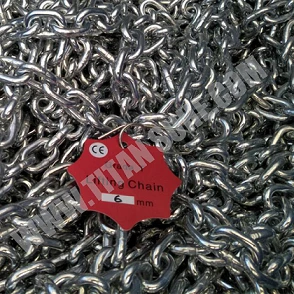
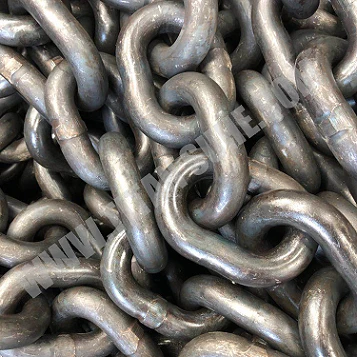
G80 chain is available with different surface treatments, including self-colour and galvanized finishes.
Self-colour chain is commonly used where the operating environment does not call for additional surface protection. Galvanized chain may be specified for outdoor or more corrosive conditions, although the exact coating and service environment still matter.
It is worth keeping surface treatment separate from chain grade. Galvanizing does not change an ordinary welded chain into Grade 80 lifting chain, and a galvanized finish should not be used as a substitute for the required material, heat treatment or testing specification.
For marine or persistently wet environments, the corrosion conditions should be discussed before the order is placed. The right finish depends on exposure, maintenance and the expected service life rather than the word "galvanized" alone.
Documentation Is Part Of The Specification
For industrial lifting products, certificates are not simply paperwork added after production.
Depending on the market and project, a customer may ask for an MTC, proof-load records, inspection reports, certificate of conformity or batch traceability. The exact documents should be agreed before production, particularly when a third-party inspection is involved.
Traceability becomes more useful when the chain is purchased in larger quantities. A batch or production reference can link the delivered chain to its manufacturing and testing records.
There is also a practical difference between a generic certificate saying "G80" and documentation that identifies the actual product specification and test basis. When comparing quotations, that difference is worth checking rather than assuming the documents are equivalent.
A Better Way To Write A G80 Chain RFQ
A specification such as: G80 chain, 13 mm, is a starting point, not necessarily a complete purchasing specification.
A more useful RFQ would identify the required grade, nominal diameter, standard, WLL or application, surface treatment and certification requirements. If the chain is intended for a sling assembly, the number of legs and working configuration should also be stated.
That gives the manufacturer enough information to quote the same product that other suppliers are quoting.
For buyers comparing several factories, this can make a bigger difference than a small change in unit price. If two quotations are based on different standards, testing requirements or documentation, the prices are not really comparable yet.
G80 chain selection is therefore less about finding a diameter from a catalogue and more about matching the chain specification to the lifting application. Once the WLL, standard and working conditions are clear, the appropriate chain size and supporting documentation are much easier to establish.