


When I first started working as a wire rope sling supplier, I thought the difference between slings from different countries came down to little more than price. Early on, I sourced a batch from a manufacturer overseas that seemed like a steal at the time—but that experience taught me how wrong that assumption is. We ended up with slings that frayed after two uses, failed load tests we ran in-house, and put our clients at serious risk. Now, after years of partnering with factories across three continents, I can tell you: the difference between wire rope slings made in different countries isn’t just about where they’re produced. It’s about material standards, manufacturing processes, quality control, and the deep understanding that each region brings to making a product that has to hold thousands of pounds (or more) in critical applications.

Let’s start with the foundation of any good wire rope sling: the wire rope itself. Countries like the U.S. and Germany have some of the strictest standards for raw materials. Their steel for wire ropes is typically produced to meet ASTM (American Society for Testing and Materials) or DIN (Deutsches Institut für Normung) specifications, which dictate everything from the tensile strength of the steel to the consistency of every strand in the rope. For example, a galvanized wire rope sling from a U.S. manufacturer will use steel that’s tested for coating thickness to ensure it resists corrosion in harsh environments—whether that’s a shipyard in the Gulf of Mexico or a construction site in the Pacific Northwest. That’s not to say all slings from other regions skimp on materials, but many manufacturers in lower-cost regions might use steel that meets a lower, region-specific standard. They might cut corners on the amount of zinc in galvanization, or use steel with slight inconsistencies in strand thickness that add up to weaker slings over time.
Next, look at the manufacturing methods. There are several types of wire rope slings, each made with specific techniques, and these techniques vary dramatically by country. Let’s take pressed wire rope slings, which are among the most common and durable for heavy lifting. The process here involves compressing the end of the wire rope with a steel sleeve to secure the strands without splicing. U.S. and Canadian factories tend to use precision hydraulic presses that apply consistent, even pressure around the entire sleeve, ensuring the strands are tightly packed and the load is distributed evenly. This is why our Pressed Wire Rope Slings Galvanized Ungalv line has such a strong track record—we work with factories that have been perfecting this press method for decades, testing every batch for compression strength to meet OSHA (Occupational Safety and Health Administration) rules.
In contrast, some manufacturers in parts of Asia or South America might use manual pressing or older, less precise machinery. This can lead to uneven compression: one side of the sleeve is tighter than the other, creating weak points where the wire rope can pull free under load. I’ve seen this firsthand on a job where a construction crew used slings from a non-U.S. manufacturer for lifting steel beams. The uneven pressing caused the sleeve to slip, and though no one was hurt, the beam dropped a few feet, damaging equipment and delaying the project. It’s an avoidable mistake, but one that happens when factories prioritize speed over the precision required for safe slings.
Another type of sling is the soft eye spliced loop wire rope sling, which is made by splicing the wire rope into a loop at the end. This is a more labor-intensive method, and the quality of the splice depends heavily on the skill of the workers. European manufacturers, especially in the UK and Italy, have a long history of rope splicing, with workers who complete years of training to get their splice techniques just right. They follow strict guidelines for splice length, number of tucks, and how tight each tuck should be to ensure the loop can handle the full load without failing. Our Soft Eye Spliced Loop Wire Rope Slings are made with craftspeople who have mastered this technique—each splice is inspected visually and with load testing before it leaves the factory.
I’ve noticed that some factories in Eastern Europe also do excellent work with soft eye slings, often at a more competitive price than Western Europe, but still holding to high standards. The biggest gap here is with manufacturers that don’t invest in training their workers properly. If a splice is done with too few tucks, or tucks that are too loose, the loop can come undone during lifting. This is a major safety hazard, especially in industries like oil and gas or marine, where sling failure can lead to catastrophic accidents.
Then there’s the cable laid grommet sling, a type of sling where the wire rope is formed into an endless loop with no ends, making it ideal for wrapping around large loads. The manufacturing of grommet slings requires bending the wire rope into a circle without damaging the strands, and then securing the connection with a splice or sleeve. Asian manufacturers have made huge strides in this area over the past decade, with many adopting modern equipment that can lay the cable perfectly into a grommet shape. However, there’s still variation in how they treat the ends to prevent fraying. Our Cable Laid Grommet Sling line uses factories in China that have upgraded their equipment to meet international standards, but I’ve seen grommet slings from newer manufacturers that have sharp ends sticking out, which can fray quickly when rubbing against rough loads.
Stainless steel wire rope slings are another category where country of origin makes a big difference, especially for industries like food processing, pharmaceuticals, or marine applications where corrosion resistance is critical. Stainless steel slings require high-quality SS wire with terminal stainless steel components that won’t rust or contaminate products. The U.S. and Japan are leaders in this space, producing stainless steel wire that’s made with a precise blend of alloys (like 316 stainless steel, which is more resistant to saltwater corrosion) that outperforms lower-grade stainless steel used in some other regions. Our Wire Rope Sling SS Wire With Terminal Stainless Steel Kit is made with 316 stainless steel wire and precision-machined terminals, tested to withstand harsh environments without staining or corroding.
I’ve had clients tell me they can buy stainless steel slings from a certain region for half the price of our slings, but when they use them in saltwater applications, they start showing rust within a month. That’s because those factories might use lower-grade 304 stainless steel instead of 316, or cut corners on the terminal fittings that are supposed to match the wire’s corrosion resistance. It’s a false economy—saving money upfront means replacing slings more often, and risking equipment or product damage if a rusted sling fails.
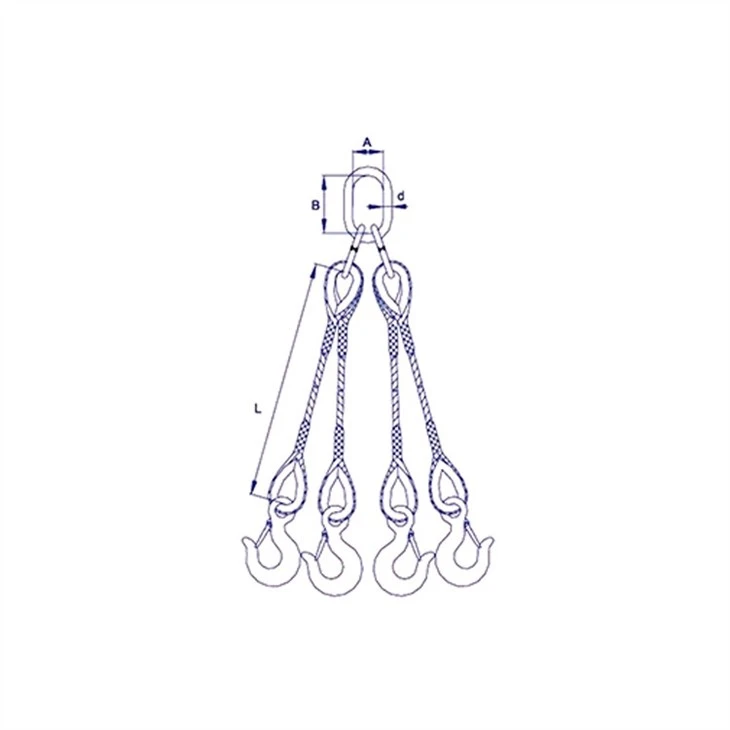
Multi-leg slings, like the 1 2 3 4 leg pressed wire rope slings with a sleeve, are used for lifting very heavy, irregularly shaped loads. These slings require precise balancing of tension across each leg to ensure the load is lifted safely and evenly. The design and engineering here are key, and that’s an area where countries with strong engineering sectors (like Germany, the U.S., and South Korea) excel. These manufacturers use computer-aided design (CAD) to calculate the exact length of each leg, the angle of each sling, and the total load capacity for each configuration. Our 1 2 3 4 Leg Pressed Wire Rope Slings with Sleeve are engineered to handle a wide range of load sizes, with each leg tested individually to ensure it can support its share of the weight.
Some lower-cost multi-leg slings from other regions are often made with unequal leg lengths, or without accounting for the angle at which the sling will be used. This can cause one leg to carry more load than it’s rated for, leading to overloading and failure. I worked with a construction company last year that had this happen—they used multi-leg slings from a non-specialized manufacturer to lift a large generator. One leg was 2 feet shorter than it should have been, so it carried 30% more weight than its rating, and it broke mid-lift. The generator fell, damaging a crane and shutting down the project for three days. That’s the kind of avoidable disaster that comes from skipping precise engineering.
Of course, it’s not all about region stereotypes. There are excellent manufacturers in every country, and there are factories in traditionally high-cost regions that cut corners. The key difference isn’t where a sling is made, but whether the manufacturer is committed to quality and safety standards. When I’m vetting a new factory, I don’t just look at their location—I look at their certifications (OSHA, ASME, ISO), their testing processes, the training of their workers, and their track record with other suppliers. I’ve partnered with a small factory in Poland that makes high-quality soft eye slings for a reasonable price, and I’ve seen factories in the U.S. that still use outdated processes that lead to inconsistent slings.
For our clients, understanding these differences is critical. If you’re lifting light, dry loads indoors, a lower-cost sling from a region with more relaxed standards might be fine— but if you’re lifting heavy loads outdoors, in corrosive environments, or in applications where safety is non-negotiable, you need to choose slings made with precision, tested to meet strict standards. That’s why our entire line of slings is made with factories that follow the highest global standards, with every batch tested for tensile strength, compression (for pressed slings), and splice integrity.
At the end of the day, a wire rope sling isn’t just a piece of equipment—it’s a lifeline for workers and a safeguard for expensive loads. When you’re choosing a sling, don’t just look at the price. Look at who made it, how it was made, and what standards it’s built to meet. If you’re looking for reliable, tested wire rope slings that are built to last, we’re here to help. Whether you need galvanized slings for construction, soft eye slings for general lifting, grommet slings for large loads, stainless steel slings for harsh environments, or multi-leg slings for heavy lifts, we have a solution tailored to your needs. Reach out to us to discuss your requirements, and we’ll help you find the right slings that balance quality, safety, and value for your projects.
References
- American Society of Mechanical Engineers (ASME B30.9): Wire Rope Slings Safety Standard
- Occupational Safety and Health Administration (OSHA) 29 CFR 1910.184: Slings
- International Organization for Standardization (ISO 2531): Wire Rope Slings – Specifications
- National Association of Chain Manufacturers (NACM): Wire Rope Sling Quality Guidelines





