


Hey there! As a supplier of lifting chains, I often get asked about how to calculate the stress on a lifting chain during lifting. It's a crucial topic, especially when safety and efficiency are on the line. So, let's dive right in and break it down step by step.
First off, understanding the basics of stress in a lifting chain is super important. Stress, in simple terms, is the force applied to the chain divided by its cross - sectional area. When you're lifting a load, the chain has to bear the weight of that load, and the stress it experiences determines whether it can handle the job safely or not.
Factors Affecting Chain Stress
There are several factors that can affect the stress on a lifting chain. One of the most obvious ones is the weight of the load. The heavier the load, the more stress the chain will experience. For example, if you're lifting a small machine part, the stress on the chain will be much less compared to lifting a large industrial container.
Another factor is the angle of the lift. When the chain is at an angle, the stress on it increases. This is because the vertical component of the force still has to support the load, but the chain also has to deal with the horizontal forces caused by the angle. A sharp angle can significantly increase the stress on the chain, so it's important to keep the lift as vertical as possible.
The type of chain you're using also matters. Different chains have different load - bearing capacities. For instance, our Grade 8 Alloy Steel Short Link Lifting Chains are made from high - quality alloy steel, which gives them a higher strength - to - weight ratio compared to some other types of chains. This means they can handle more stress while being relatively lightweight. Similarly, our Grade 10 Short Link Chain is even stronger and can withstand higher levels of stress.
Calculating the Stress
Now, let's get into the actual calculation of the stress on a lifting chain. The formula for stress (σ) is:
σ = F/A
where σ is the stress, F is the force applied to the chain, and A is the cross - sectional area of the chain.
The force applied to the chain is mainly the weight of the load. If you know the mass (m) of the load, you can calculate the weight (W) using the formula W = m * g, where g is the acceleration due to gravity (approximately 9.81 m/s² on Earth).
For example, if you're lifting a load with a mass of 500 kg, the weight of the load is W = 500 kg * 9.81 m/s² = 4905 N (Newtons).
Let's say you're using a chain with a cross - sectional area of 25 mm². First, you need to convert the area to square meters (since the SI unit for stress is Pascals, which is N/m²). So, 25 mm² = 25 * 10⁻⁶ m².
The stress on the chain is then σ = 4905 N / (25 * 10⁻⁶ m²) = 1.962 * 10⁸ Pa or 196.2 MPa (Megapascals).
However, this is a simplified calculation. As I mentioned earlier, the angle of the lift can increase the stress. If the chain is at an angle θ from the vertical, the force on the chain (F') is given by:
F' = W / cos(θ)
So, if the chain is at an angle of 30° from the vertical, cos(30°) ≈ 0.866. If the weight of the load is still 4905 N, the force on the chain is F' = 4905 N / 0.866 ≈ 5664 N.
Using the same cross - sectional area of 25 * 10⁻⁶ m², the new stress is σ' = 5664 N / (25 * 10⁻⁶ m²) = 2.2656 * 10⁸ Pa or 226.56 MPa. You can see how the angle has increased the stress on the chain.
Safety Margins
When calculating the stress on a lifting chain, it's not enough to just make sure the calculated stress is within the chain's rated capacity. You also need to consider safety margins. A safety margin is an extra buffer to account for unexpected factors such as dynamic loads (when the load is moving), wear and tear on the chain over time, and any manufacturing variations.
Most industry standards recommend a safety factor of at least 4:1. This means that the chain's rated capacity should be at least four times the maximum expected stress during normal use. For example, if the calculated stress on a chain during a lift is 100 MPa, the chain should have a rated capacity of at least 400 MPa.

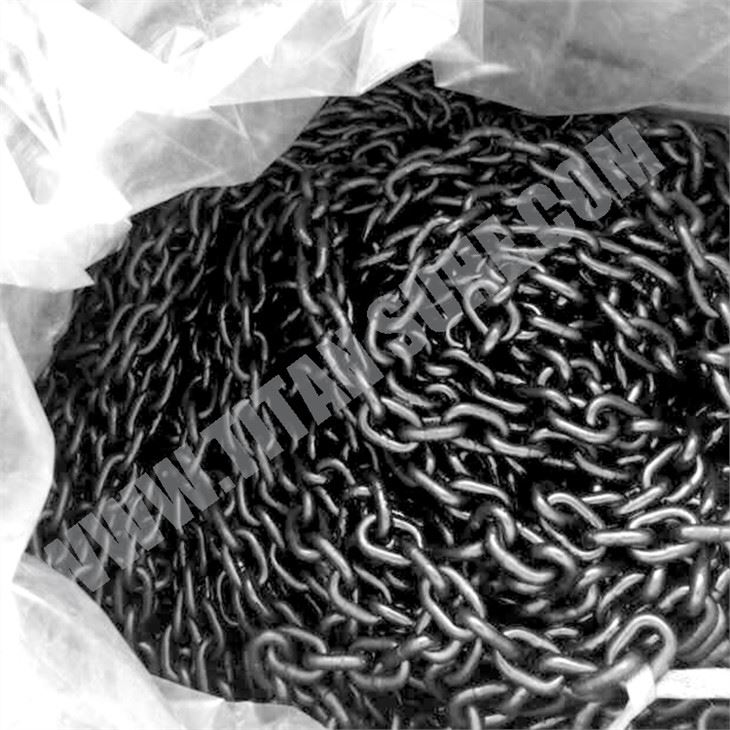
Our En Standard Grade 8 Alloy Steel Lifting Chains are designed to meet and often exceed these safety standards. They are rigorously tested to ensure they can handle the stresses they're likely to encounter in real - world lifting applications.
Inspecting the Chain
Even after calculating the stress and using a chain with an appropriate safety margin, it's important to regularly inspect the chain. Look for signs of wear, such as elongation, corrosion, or cracks. A worn - out chain may not be able to handle the stress it was originally designed for, even if the calculated stress is within the rated capacity.
If you notice any signs of wear or damage, it's best to replace the chain immediately. Using a damaged chain can lead to catastrophic failures, which can be extremely dangerous.
Conclusion
Calculating the stress on a lifting chain during lifting is a complex but essential process. By considering factors like the load weight, lift angle, chain type, and applying the right formulas, you can ensure that the chain you're using is up to the task. And remember, safety should always be your top priority.
If you're in the market for high - quality lifting chains, we've got you covered. Our range of lifting chains, including Grade 8 Alloy Steel Short Link Lifting Chains, Grade 10 Short Link Chain, and En Standard Grade 8 Alloy Steel Lifting Chains, are designed to meet the highest industry standards. If you have any questions about which chain is right for your application or want to discuss your lifting needs, feel free to reach out to us. We're here to help you make the best choice for your lifting operations.
References
- Machinery's Handbook, 31st Edition
- American Society of Mechanical Engineers (ASME) B30.9 - Safety Standard for Slings
- European Committee for Standardization (CEN) EN 818 - 2:2004 - Short - link chain for lifting purposes





