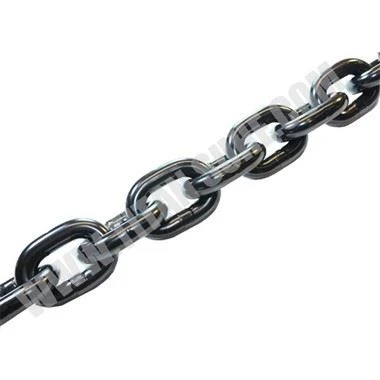
■ Lifting chain specifications
The same type of chain is divided into specifications according to the pitch, number of rows, chain width and ultimate tensile load.
■ Chain surface treatment: oiling, blackening, spraying, polishing, spray painting, hot dip galvanizing, electroplating
-Galvanizing: The method of electroplating or electroless galvanizing is used to form a galvanized layer on the surface of the part.
The zinc layer can not only be beautiful and high-strength chain, but also can be anti-corrosion. Galvanized high-strength chain-general application
In the open air.
-Heat treatment: In heat treatment equipment, various auxiliary media are used at high temperature to improve zero.The organizational structure of the parts improves various physical properties.
-Quenching: After the parts are heated to a certain temperature in the heat treatment equipment, they are kept for a certain period of time.Cool in the same medium to improve the hardness of the parts.
-Tempering: After quenching, the parts are heated at a certain temperature in the heat treatment equipment and kept for a fixed time
After cooling. After the parts are tempered, the quenching hardness can be reduced, the quenching stress can be eliminated, and the toughness can be improved.
-Oiling: After the high-strength chain is oiled, it can prevent the high-strength chain from rusting, and it is more shiny.
■ Visual inspection of the chain
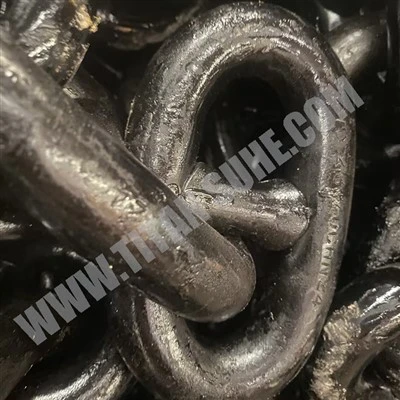
1. Check whether the inner/outer chain piece is deformed, cracked or embroidered;
2. Check whether the pin is deformed or rotated or is embroidered;
3. Check whether the roller is cracked, damaged or excessively worn;
4. Check whether the joint is loose and deformed;
5. Check whether there is abnormal noise or abnormal vibration during operation, and whether the chain lubrication is in good condition.
■ Maintenance
1. The sprocket should be installed on the shaft without swing. When the center distance of the sprocket is less than 0.5 meters, the allowable deviation is 1 mm; when the center distance of the sprocket is more than 0.5 meters, the allowable deviation is 2 mm. However, it is not allowed to rub the side of the sprocket tooth. If the two-wheel knitting is too large, it is easy to cause chain disconnection. When replacing the sprocket, operator should pay attention to check and adjust the offset.
2. The tightness of the lifting chain should be appropriate. Tight too much increases power consumption and bearings are easy to wear; If the chain is too loose, it will be easily jump and fall off. The appropriate tightness of the chain is lifted or pressed down from the middle of the chain, the center distance between the two sprockets is about 2%-3%.
3. The new lifting chain is too long or stretched after use, which is difficult to adjust. You can remove the chain link depending on the situation, but it must be an even number. The chain link should pass through the back of the chain, the lock piece should be inserted outside, and the opening of the lock piece should face the opposite direction of rotation.
4. After the sprocket is worn, the new sprocket and the new chain should be replaced at the same time. It is not allowed to just a new chain or a new sprocket alone. Otherwise it will cause poor meshing and accelerate the wear of the new chain or new sprocket. When the tooth surface of the sprocket is worn, it should be turned over.
5. The old lifting chain cannot be mixed with part of the new chain, otherwise it is easy to produce an impact and break the chain.
6. Remember to fill the lubricating oil in time. The lubricating oil must put in the gap between the roller and the inner sleeve, thus improve working conditions and reduce wear.