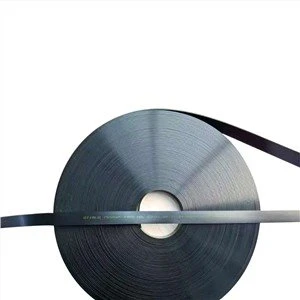
The world's most frequently used elevator wire rope is constructed with 6 strands and 19 wires per strand. Structured with Seale strand or Filler strand or Warrington strand and fiber core at the center, the 6 strands elevator wire ropes has very good bend fatigue and elongation performance. When this wire rope structured with synthetic fiber core, it is mostly used as governor ropes. When it comes with natural fiber core, it is more used as suspension ropes.
6x19S (9-9-1)
This wire rope is Seale strand constructed which has thick outer wires that provides a higher degree of resistance against external wear in use when the wire rope runs over the traction sheave and the deflection points. Therefore, 6x19s is the most frequently used strand construction for elevator ropes.
6x19W (6+6-6-1)
This wire rope is Warrington strand constructed with the features of far thinner wires in the outer strand than a Seale strand. This makes for a great reduction in flexural stress. With 20-40% longer service life than comparable ropes made of Seale strands, this wire ropes are more used in traction elevators with double-wrap drives and in roped hydraulic elevators.
6x25F(12-6F-6-1)
Filler strand constructed elevator ropes have very good fatigue bending properties. 25 wires in each strand makes the rope very flexible. Because the filler wires are extreme thin, rope diameters 10mm and below are not recommended with filler stand. And rope diameter over 16mm need to be designed as filler construction due to it improved flexibility.
APPLICATIONS OF GALVANIZED STEEL WIRE ROPE 6X19
1. Where steel cables are required to wind on drum such as hand winch, electric winch, electric wire rope hoist
2. Where steel cables are required to run over pulleys such as snatch blocks, cranes, etc.
3. For all general engineering applications
4. To make pressed or spliced wire rope slings
5. Work as control cables for equipment
SURFACE TREATMENT
Bright and Galvanization optional
PACKING
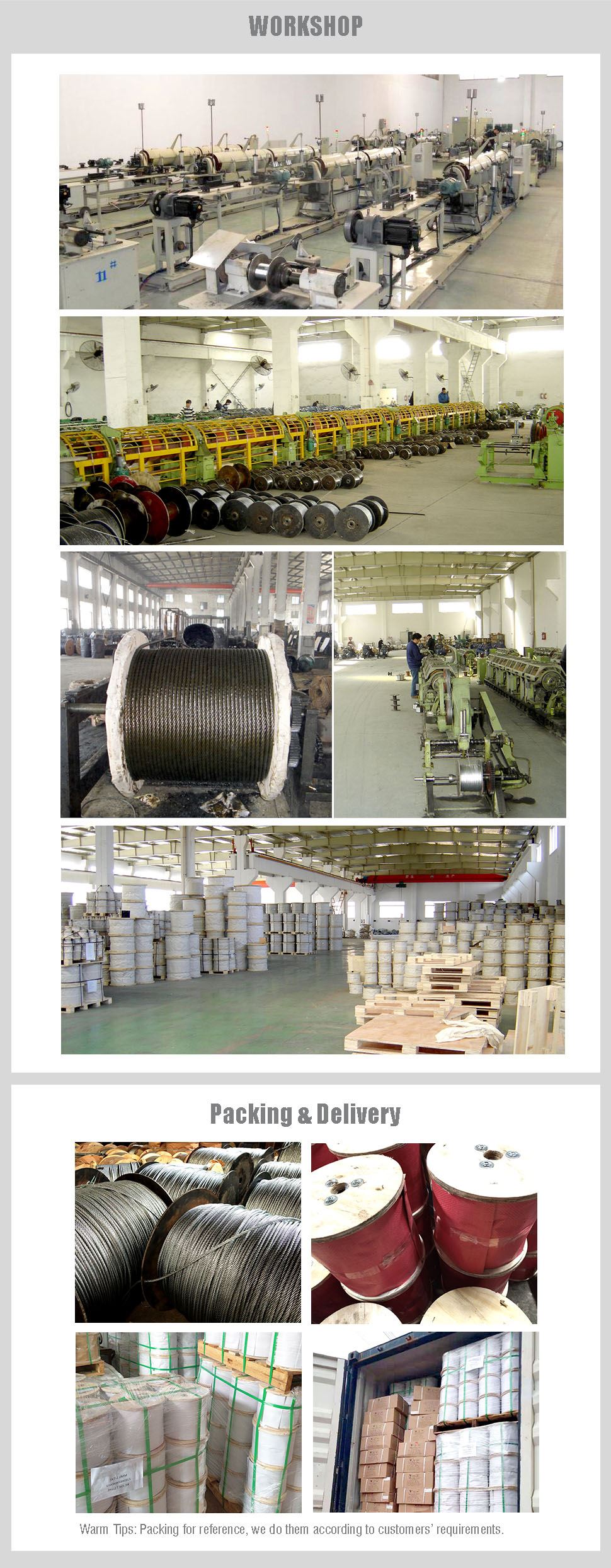
■ Certain meters on one polywood reel.
■ Each reel wrapped by moisture proof woven bag.
■ Certain reels stack on one pallet or in one wooden case.
CONSTRUCTION
6x19S(9-9-1)+FC,6x25F(12-6F-6-1)+FC, 6x19W(6+6-6-1)+FC
Natural fiber core(NFC): Used as suspension ropes of low-speed, low-rise, low duty elevators.
Synthetic fiber core(SFC): Used as governor ropes

Nominal Diameter mm | Approx weight | Nominal Tensile Strength | ||||||
kg/100m | Minimum Breaking Strength (kN) | |||||||
1180/1770N/mm2 | 1320/1620N/mm2 | 1370/1770N/mm2 | 1570/1770N/mm2 | 1570N/mm2 | 1620N/mm2 | 1770N/mm2 | ||
6 | 12.9 | 16.3 | 16.8 | 17.8 | 19.5 | 18.7 | 19.2 | 21 |
6.3 | 14.2 | 17.9 | / | 21.5 | 21.2 | 23.2 | ||
6.5 | 15.2 | 19.1 | 19.7 | 20.9 | 22.9 | 21.9 | 22.+ | 24.7 |
8 | 23 | 28.9 | 29.8 | 31.7 | 34.6 | 33.2 | 34.2 | 37.4 |
9 | 29.1 | 36.6 | 37.7 | 40.1 | 43.8 | 42 | 43.3 | 47.3 |
9.5 | 32.4 | 40.8 | 42 | 44.7 | 48.8 | 46.8 | 48.2 | 52.7 |
10 | 35.9 | 45.2 | 46.5 | 49.5 | 54.1 | 51.8 | 53.5 | 58.4 |
11 | 43.4 | 54.7 | 56.3 | 59.9 | 65.5 | 62.7 | 64.7 | 70.7 |
12 | 51.7 | 65.1 | 67 | 71.3 | 77.9 | 74.6 | 77 | 84.1 |
12.7 | 57.9 | 72.9 | 75 | 79.8 | 87.3 | 83.6 | 86.2 | 94.2 |
13 | 60.7 | 76.4 | 78.6 | 83.7 | 91.5 | 87.6 | 90.3 | 98.7 |
14 | 70.4 | 88.6 | 91.2 | 97 | 106 | 102 | 105 | 114 |
14.3 | 73.4 | 92.4 | / | / | 111 | / | / | 119 |
15 | 80.8 | 102 | / | 111 | 122 | 117 | / | 131 |
16 | 91.9 | 116 | 119 | 127 | 139 | 133 | 137 | 150 |
17.5 | 110 | 138 | / | / | 166 | / | / | 179 |
18 | 116 | 146 | 151 | 160 | 175 | 168 | 173 | 189 |
19 | 130 | 163 | 160 | 179 | 195 | 187 | 193 | 211 |
20 | 144 | 181 | 186 | 198 | 216 | 207 | 214 | 234 |
20.6 | 152 | 192 | / | / | 230 | / | / | 248 |
22 | 174 | 219 | 225 | 240 | 262 | 251 | 259 | 283 |
REMARKS
■ The approx.weight is for reference, not used for trade.
■ We reserve the right to alter specifications
■ The data reference standard GB8903-2005 or ISO4344-2004
Elevator Wire Rope Applications | |||
Core Strand | Construction | Applications | Remarks |
6X19FC | 6x19S+SFC | Governor ropes | Recommendation: |
6x19S+NFC | Suspension ropes for low-rise | ||
8X19FC | 8x19S+SFC | Governor ropes | |
8x19S+NFC | Suspension ropes for elevator | Please specify when ordering | |
8x19S+GSF | Suspension ropes for elevator | ||
8X19 steel core | 8x19S+IWRC | Suspension ropes for elevator | A technical agreement needs |
8x19S+IWRF | Suspension ropes for elevator | ||
9x19 Steel Core | 9x17S+IWRC | Suspension ropes for elevator | |
9x17S+IWRF | |||
6x36+FC | 6x29F+FC | Compensation ropes | |
HOW TO MAKE CHOICE
Application | Rope Construction | Rope diameter mm | Tensile strength (N/mm2) | |
Japanese | Governor ropes | 6x19S+FC | 6mm-10mm | 1320/1770 |
Suspension ropes | 8x19S+FC | 8mm-16mm | 1320/1770 | |
Governor ropes | 6x19S+FC | 6mm-10mm | 1320/1770 | |
European | Suspension ropes | 8x19S+FC | 8mm-16mm | 1370/1770 |
Steel Wire Rope 6x19 is a compacted wire rope that most used to make wire rope slings or to run over pulleys or drums as crane ropes or winch ropes. This rope has features of super flexibility in diameter 3mm to 16mm. It is available with fiber core or independent wire strand core. When supplied with independent wire steel core, the rope is more referred to as 7x19.
UNWINDING AND INSTALLATION OF WIRE ROPES
General requirements
The installation steps of the wire rope should be carried out in accordance with the work instructions formulated by the wire rope user.
It should be checked that wire ropes have not been damaged during unloading and transport to storage. During these operations, the wire rope itself must not come into direct contact with any part of the lifting device, such as the fishing hook of the crane or the fork bucket of the fork-lift truck. Such damage can be avoided by hoisting the wire rope with a braided sling.
Wire rope supplied in coil
When unwinding, the wire rope coil should be placed on a clean ground and rolled along a straight line. It should not be dragged on the ground to prevent abrasion damage and damage, and ensure that it will not be polluted by dust, sand, rain or other harmful substances.
The unwinding method of pulling the wire rope directly from the stationary coil is prohibited, as this will wind the wire rope into the coil and create a kink.
If the wire rope coil is too large and cannot be turned manually, you need to place the wire rope on a wire rack that can rotate freely, and then pull the end of the wire rope coil to release the wire rope.
Wire ropes supplied as axles
A shaft of sufficient strength should be passed through the center hole of the axle, and the axle should be placed on a suitable stand that can turn and have a brake that prevents excessive rotation of the axle during installation.
When the wire rope needs to be wound in multiple layers on the reel, the axle should be placed on a device that can provide the wire rope with a back tension of 1%~2% of the minimum breaking force of the wire rope, so that the back tension can be transmitted from the axle to the reel, so as to ensure that the underlying loop wire rope on the reel, especially the wire rope of the lowest layer, can be tightly wound on the reel.
The supply sheave shaft should be placed in a suitable position to ensure the minimum deflection angle during wire rope installation.
If there is an annular ring on the wire rope during the installation process, the axle should be hoisted and rotated in the opposite direction along the annular ring to eliminate it.
The installation of the axle bracket should ensure that the wire rope does not bend in the opposite direction during the process of unwinding and threading the rope. That is, if the wire rope on the reel is down-rolled, the wire rope on the supply sheave shaft should also be pulled out from the bottom.
When manpower is used to release the wire rope from the axle, the axle should be placed on a freely rotating and controlled support, and the end of the pulling wire rope can be used to release the wire rope.
Unwinding by rolling the axle on the ground or unwinding the wire rope from the standing axle is prohibited, as this will cause damage or kink to the surface of the wire rope.
Special controls should be exercised when unfastening the outer end of the wire rope from the supply sheave shaft or coil. When the restraint is released or the end is fixed, the wire rope will automatically straighten. If not controlled, the wire rope will bounce violently and may cause personal injury.
The wire rope should be kept in the state of manufacture during installation.
Cutting of wire rope
If the wire rope needs to be cut, the wire rope should be tied firmly on both sides of the cut mark. For multi-strand wire rope, the length of each bundle should be at least twice the diameter of the wire rope.
Hot Tags: 6 strand steel wire ropes for traction elevators, China, suppliers, manufacturers, factory, free sample, Wire Rope Clips, Light Curtain Accessories, Grade 80 sling hooks, Wire Rope Sleeves And Socket, Grade 80 Weld on Hook Light Type, Grade 70 Alloy steel clevis lug link